Various reminders that this is the traditional time to be making marmalade have tempted me to have a go. Firstly, emails from ‘Riverford Organics’ tried to sell their ‘Marmalade Making Kit’. This sounded like a great offer until I realised that the ‘kit’ consisted of organic Seville oranges, lemons and a recipe. The Riverford site has their recipe complete with instructional video. It didn’t look too difficult…
A recipe for marmalade also turned up in the magazine I was reading last weekend (LandScape issue 44 Jan/Feb 2018). By the time I had decided to add the marmalade kit to my Riverford order, it had sold out. There was, however, a bowl of oranges in the kitchen that people had been ignoring and I had already had to throw a couple of rotten ones into the compost. Gathering together all the empty jars I could find, I realised I didn’t have enough. A trawl though local shops resulted in my buying a big, new stainless steel pan, 2 kilograms of sugar and some small jars. That very day, a used copy of ‘Forgotten Skills of Cooking’ by Darina Allen, as recommended by June Molloy Vladička of My Food Odyssey ( https://myfoododyssey.com/books/ ) was delivered from Amazon. This book has several recipes for marmalade and guidance for success with preserves. Suddenly I was awash with recipes and advice. It was time to have a go myself and document my attempts on Mrs Bloggins.
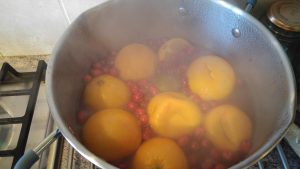
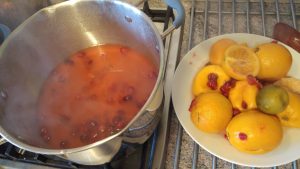
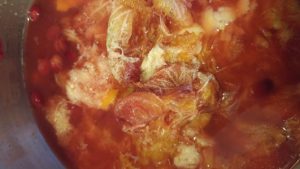
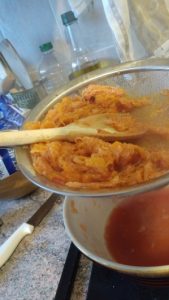
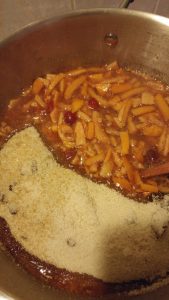
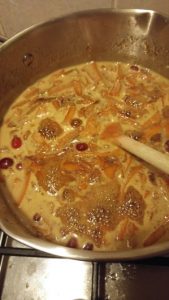
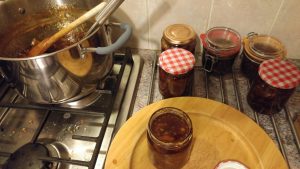
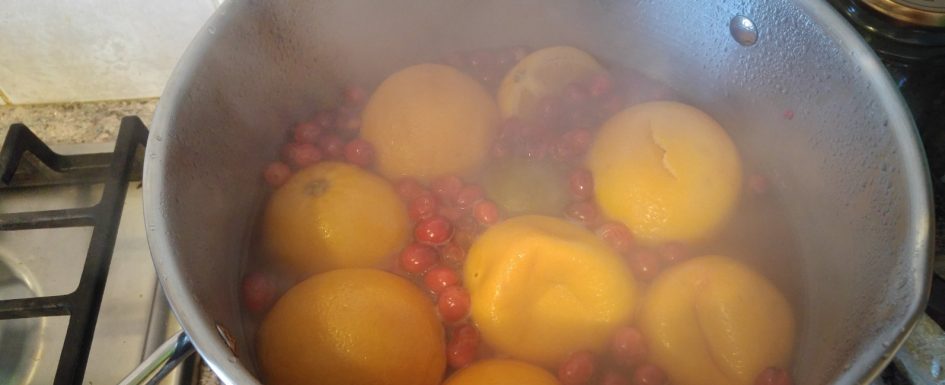
As there are numerous recipe sources for marmalade, they will not be repeated here. I used a little over 1 kg of fruit in each batch. The amounts of fruit and sugar tend to be similar but there are differences in techniques. The Riverford recipe removes the peel from the fresh fruit, slices it and then boils it in water with the remains of the oranges and lemons which have been tied up in a muslin cloth to keep separate from the peel. Other sources suggest boiling the fruit whole in water, then removing the peel and cutting it into slices while the rest of the fruit is separated by sieving from the final mix before adding the sugar. Having found a source of Seville oranges in Neath Market, I decided to try out these two different options for myself. One of my quirks is a tendency not to like to do things the same way twice. I also have a habit of tweaking recipes, so my first attempt continued scouring the kitchen for left-overs by including fresh cranberries which had been in the ‘fridge since before Christmas. I also substituted of brown muscovado sugar for the normal white granulated hoping this would give the resulting product a more ‘traditional’ look. The final product has a nice tawny colour.
| Pictorial guide #1 |
|
|
|
|
|
|
|
|
|
|
|
|
|
|
|
|